
Let's start with the honest part
Mismatched orgasm timelines are one of the most common things couples never talk about. One person climaxes in five minutes. The other needs twenty. One finishes and wants to be done. The other is just getting started. The result is usually awkward silence, performance pressure, and a slow fade in sexual connection.
Here's what most couples don't realize: a lemon clitoral vibrator doesn't fix this problem by rushing anyone along. It fixes it by making the gap irrelevant. Instead of one person waiting or faking, you both get what you actually want at the same time.
Why orgasm timing mismatches happen
First, the biology. Bodies are wildly different in how they respond. Penis-havers tend to finish faster on average, but that's not a rule. Vulva-havers vary enormously too. Some people warm up in minutes. Others need sustained stimulation for fifteen, twenty, even thirty minutes to reach orgasm. Medication, stress, age, and hormones all shift these timelines week to week.
Second, the psychology. If you've spent years in a pattern where one person is "the quick one" and the other is "the slow one," you start performing based on that script. The faster person rushes to avoid seeming selfish. The slower person rushes to avoid seeming demanding. Nobody wins.
Third, the relationship dynamic. Orgasm timing gets tangled up with whose pleasure matters more, who's responsible for whose satisfaction, and whether both people's bodies deserve space and time. It's rarely just about biology.
What a lemon vibrator actually does for this
A lemon vibrator like the Lem works differently than penetrative sex. It gives focused, consistent stimulation to the external clitoris. That matters because it lets both partners participate in the experience without one person's pace controlling the other's.
Here's the practical version. Let's say you finish orgasm in eight minutes and your partner needs eighteen. Instead of waiting silently or switching to manual stimulation that gets exhausting, you hand them the lemon vibrator. They use it while you're still present, still touching them, still connected. No waiting. No performance. Just continuation.
Or the reverse. Your partner finishes first. Instead of the typical dead zone where they're done and you're frustrated, they can use the lemon sucker on you while you're close. The rhythmic stimulation often makes it easier to climax, and you're not left feeling abandoned mid-arousal.
The key is that nobody's waiting for anybody. Both people are moving through arousal and orgasm at their own pace, with support instead of resentment.
The conversation you actually need to have first
Before you bring a lemon clitoral vibrator into the bedroom, you need one conversation. Not a big dramatic talk. Just honest.
Here's what I recommend asking your partner:
"I've noticed our orgasm timing feels different. I want us to both feel good without either of us rushing or waiting. How would you feel about trying a toy that lets us both get what we need?"
Notice what's not in that sentence: blame, pressure, or implication that something is wrong. You're naming the observation and offering a solution that benefits both of you.
Some partners will get it immediately. Others will worry they're not "enough" anymore. That's real anxiety that deserves acknowledgment. The message isn't "I need this instead of you." The message is "I want us to stay connected even when our bodies work at different speeds."
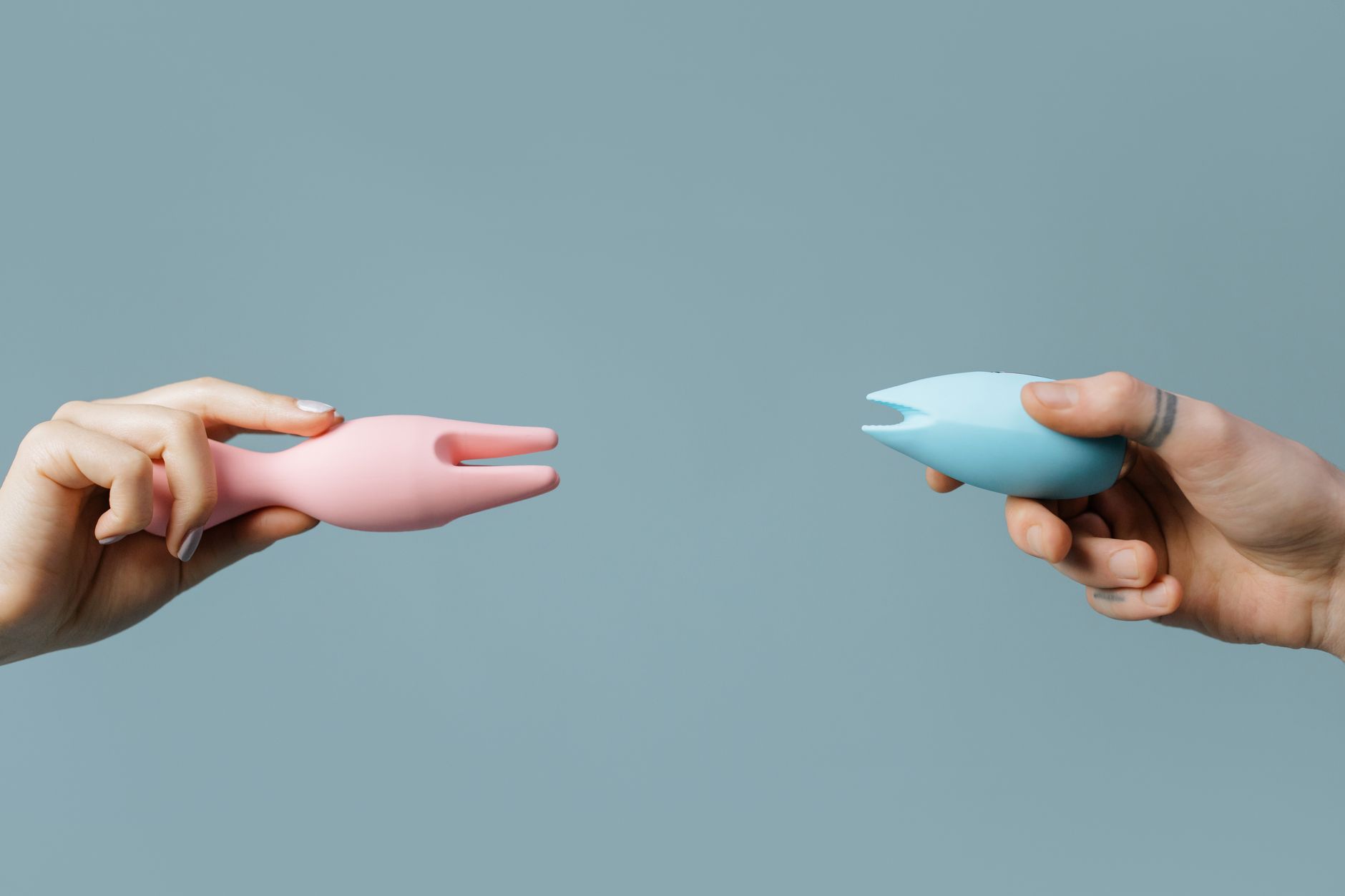
Photo by cottonbro studio on Pexels
If your partner is hesitant, ask what they're worried about. Is it about jealousy? Feeling replaced? Performance pressure? Each worry needs a different conversation. Sometimes the answer is "I'll use it on you, not just myself." Sometimes it's "Let's try it together the first time with no pressure." The vibrator isn't the conversation. The vibrator is the starting point.
Practical ways to actually use it together
Let's talk mechanics, because logistics matter.
The "both orgasming close to the same time" scenario: You're having sex or making out, getting close to orgasm, and your partner still has a ways to go. Hand them the lemon vibrator. They can use it on themselves while you continue however you want. The vibration + your presence often makes their arousal accelerate naturally. You're not competing. You're complementing.
The "one person just finished" scenario: They come first. You're still climbing toward orgasm. Instead of them lying there or leaving the bed, they can use the lemon sucker on you while you finish. This does two things: one, it gives you focused stimulation that often makes climax easier to reach. Two, it keeps your partner involved instead of exiling them to the sidelines.
The "building sustained arousal together" scenario: Sometimes the goal isn't even orgasm. You both just want to stay turned on longer without the pressure of anyone having to finish. Using a lemon clitoral vibrator on yourself while your partner does what they want means you can both enjoy arousal at your own pace without anyone performing.
The "communication while it's happening" scenario: This is the one most couples skip, and it's the most important. While someone's using the vibrator, keep talking. "Does this feel good?" "Want me to touch you here?" "Tell me when you're getting close." This keeps it intimate instead of mechanical.
Why a lemon vibrator specifically
There are a lot of clitoral vibrators out there. The Lem and similar lemon-shaped designs work particularly well for couples because they're intuitive. The suction-cup design gives consistent stimulation without the numbness that can happen with traditional vibration. For partners who need sustained arousal to reach orgasm, that matters.
Also, the shape is weirdly less intimidating for couples who are new to toys. It's cute. It's discreet. It doesn't look like a dramatic statement.
If you have a partner who's never used a clitoral vibrator, starting with one designed for sensation and ease of use (rather than intensity) makes the first experience about pleasure, not overstimulation.
The emotional part nobody discusses
Using a toy with a partner can feel vulnerable. Someone might worry: "Am I not enough?" "Does this mean they're not attracted to me?" "Will they prefer the toy to me?"
These are normal feelings. The answer to all three is usually no. But naming them out loud helps.
Here's what I tell couples: "A vibrator isn't a replacement for you. It's a tool that lets your partner's body do what it does naturally. You're not losing anything. You're actually gaining time together because neither of you has to perform anymore."
When one partner can access orgasm without the other person's exhaustion or timing being a limiting factor, it often strengthens the whole connection. You both feel better. You both feel wanted. You're not keeping score.
When to reconsider the approach
If you've introduced a lemon vibrator and one partner still feels resentful or avoided, that's not a toy problem. That's a relationship problem that needs a conversation (or maybe a therapist).
Similarly, if one person is using the vibrator to avoid touching or connecting with their partner, you've missed the point. The tool should enhance intimacy, not replace it.
The goal isn't to fix everything with a toy. The goal is to remove the logistical barrier so you can actually be present with each other, even when your bodies have different rhythms.
Practical care notes
If you're sharing a lemon clitoral vibrator between partners, wash it with warm water and mild soap after use. Keep it clean, charged, and stored somewhere you both feel comfortable accessing it. There's no shame in leaving it out on the nightstand.
FAQ
Why do partners have different orgasm timelines in the first place?
Physiology, psychology, and relationship dynamics all play a role. Hormones, medication, stress, and age affect arousal speed differently for different bodies. Additionally, if one partner has spent years rushing through arousal or performance anxiety builds up, the timeline can become conditioned. Sometimes it's just how two bodies are wired.
Does using a lemon vibrator during partnered sex mean someone isn't satisfied?
Not at all. It usually means the opposite. Someone is removing the barrier between their arousal and orgasm so they can stay present and connected. Using a vibrator doesn't mean you're unhappy with your partner. It means you're removing the friction (literally and figuratively) that gets in the way of both of you feeling good.
How do I bring this up without hurting my partner's feelings?
Focus on your own body and needs, not theirs. Instead of "You take too long," try "I'd love for us to both finish feeling satisfied without anyone rushing." Frame it as something you want to do together, not something you're doing because they're not enough.
Will my partner think I'm not attracted to them if I suggest using a toy?
Many partners worry about this. The direct answer is usually no, but your partner might feel that way at first. That's why the conversation before matters. Be clear that you're attracted to them and this is about extending the pleasure both of you get, not replacing them.
What if my partner doesn't want to use a toy together?
Respect that. But ask what they're worried about. Sometimes it's not about the toy. It's about feeling like something's missing in the relationship or worries about performance. If they stay firm, that's their boundary. You can still use a vibrator on yourself during partnered sex if that works for you.
Can lemon vibrators actually help someone orgasm faster?
Yes, often. The concentrated suction stimulation can accelerate arousal for many people, which is useful when one partner is much slower. But the point isn't to make anyone rush. The point is to give both people what they actually need so you can finish around the same time without resentment.
The bottom line
Mismatched orgasm timelines destroy sex lives quietly. One person starts feeling like a burden. The other starts feeling unseen. Both people perform instead of feeling. A lemon clitoral vibrator doesn't solve relationship problems, but it removes one logistical excuse that keeps couples from actually connecting.
When neither person is waiting or performing, you're free to just be together. That's worth the conversation and the tiny investment in a tool that works.
Ready to have this conversation with your partner? Start with the question I mentioned above, and see where honesty takes you. If you want more guidance on navigating this shift, reach out to us. We're here to help.